Weekday test
Drive office, school, and hospital routes at real timings before treating brochure minutes as reliable.
Sarjapur Road tech-park orbit, the planned Sarjapur metro 2.5 km away, daily-life maturity in Chambenahalli, and the water source mix at April 2028 possession.
Amberstone Vectra's location story is a 2026-to-April-2028 story. Today, Chambenahalli (Sarjapura Hobli) is an emerging Sarjapur Road pocket with stronger arterial logic than neighbourhood maturity. By the time the four towers hand over in April 2028, the buyer is hoping for a more complete residential ecosystem supported by the Varthur-Sarjapur Main Road arterial, the planned Sarjapur metro station 2.5 km away, continued Sarjapur Road tech-park absorption, and improved Sarjapura Hobli social infrastructure. For location reading, Aparna Wonder Woods keeps the context local: commute anchors, school access, hospital reach, retail convenience, and last-mile movement decide whether the address works.
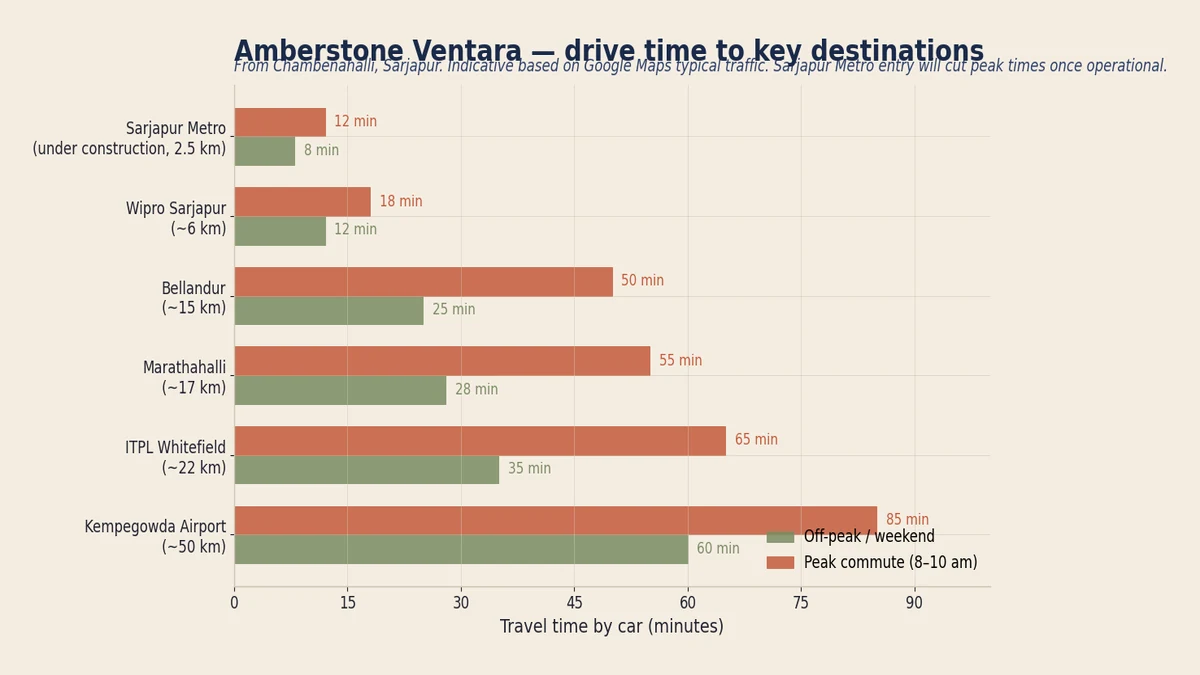
The site is at Survey No. 131, Sarjapura Hobli, Chambenahalli, about 5 minutes off the Varthur-Sarjapur Main Road arterial. The daily commute orbit is the Sarjapur Road tech-park belt - Wipro Sarjapur, Bellandur, Marathahalli, Whitefield. The planned Sarjapur metro station on the Sarjapur-Hebbal Phase 3 Blue Line is 2.5 km away and targeted for operations in the 2028-2030 window, broadly tracking the project's possession timeline.
Macro drivers matter only when translated into daily questions: how long is your school run from Chambenahalli, where is the nearest specialty hospital, what does the Sarjapur Road feeder look like at 8:30 AM and 7:00 PM, and are weekend retail and dining options on Sarjapur Road close enough that the family does not feel cut off? Walk those routes at your real timings before treating the address as a solved problem.
Chambenahalli today is not central Sarjapur Road. That is both the opportunity and the caution. More central Sarjapur Road pockets command higher prices because their schools, hospitals, retail and rental absorption are already in place. Chambenahalli offers a lower entry into the corner-home / Vastu / Mini Forest planning DNA, with social-infrastructure thickening expected as rooftops grow along the arterial.
The balanced reading: Amberstone Vectra works well for buyers whose workplace is on Sarjapur Road or the ORR South tech belt, who specifically value corner-home / Vastu / 11 ft planning, and whose family timeline aligns with April 2028 possession. It is less suitable for buyers who need a mature retail-and-school ecosystem at the gate today.
The developer location map below sets out the connectivity pitch in one frame: Sarjapur Main Road access, the Sarjapur Junction, Orion Uptown Mall, the Bangalore CBD drive, and nearby junctions at Chambenahalli, Petanahalli, and Huskuru. Read it as the marketing claim, not as a verified commute. Every drive-time number on it should be checked at your own peak hour from the actual residential gateway before treating it as a feature of the home.
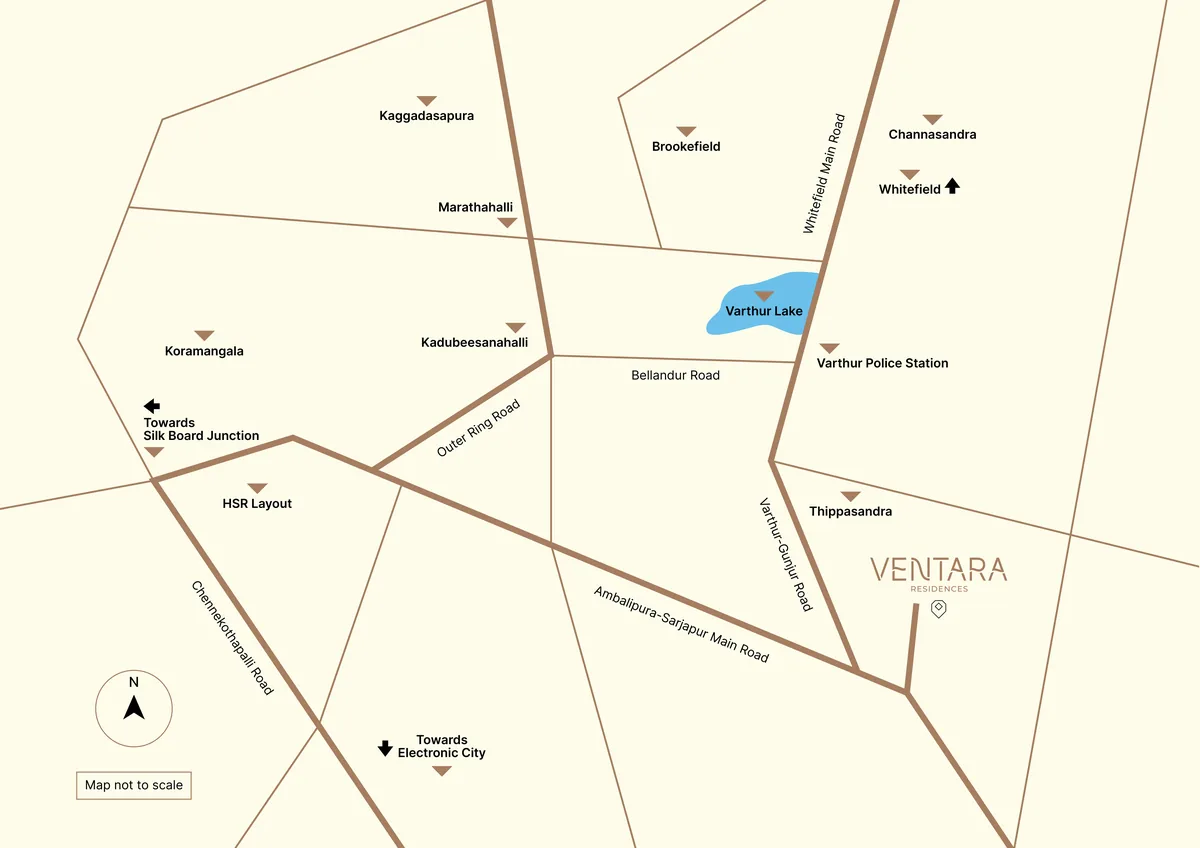
Use the map as a checklist, not a conclusion. For each labelled landmark - schools, hospital, mall, sports arena, lake - confirm the specific name, the actual road route from the residential gateway (not the sales-office entry), the peak-hour drive time, and whether the route depends on a service road, U-turn, or toll-plaza crossing that the map glosses over. The neighbourhood is shown as a balanced semi-urban belt; on the ground it is still an emerging corridor with uneven last-mile maturity.
The map also does not show the internal site layout, plot or tower boundaries, entry/exit points, or phase boundaries - those live on the master plan and key plan. Treat this drawing strictly as a location-advantage summary, and pair it with a real Google Maps drive at the times of day your household will actually use the route.
| Destination / route | Planning relevance | Buyer caution |
|---|---|---|
| Varthur-Sarjapur Main Road | Primary feeder, ~5 min from the site, connects to the Sarjapur Road tech-park belt | Peak-hour bottlenecks at 8:30 AM and 7:00 PM can materially change travel time. |
| Wipro Sarjapur | Closest large tech park (~10 km) | The main daily-commute reference for many Sarjapur Road buyers. |
| Bellandur / RMZ Ecospace | Major tech-park cluster (~18 km) | ORR South stretch sees heavy peak-hour congestion; test before booking. |
| Marathahalli | Tech and retail anchor (~22 km, 45-55 min) | Drive time depends heavily on ORR junction behaviour. |
| Whitefield / ITPL | East Bangalore tech-park anchor (~25 km) | Reachable but not a short daily commute; suits buyers with hybrid schedules. |
| Planned Sarjapur metro station | ~2.5 km, on Sarjapur-Hebbal Phase 3 Blue Line, targeted 2028-2030 | Treat as upside, not a guaranteed daily-commute solution at handover. |
| Kempegowda International Airport | ~55 km via Sarjapur Road and ORR | 80-100 minute drive depending on traffic; not a frequent-flyer-friendly distance. |
The Varthur-Sarjapur Main Road arterial is the immediate location strength. It connects Chambenahalli to the entire Sarjapur Road tech-park belt - Wipro Sarjapur, Bellandur, Marathahalli, Whitefield - through one primary feeder. For households whose workplace sits in that belt, the commute is practical when timed correctly; for households whose work is in central or north Bengaluru, the daily trip is meaningfully longer.
The planned Sarjapur metro station 2.5 km from the site (Sarjapur-Hebbal Phase 3 Blue Line) is a high-impact long-term catalyst. The line is targeted for operations in the 2028-2030 window, which broadly tracks the project's April 2028 possession date. Buyers should treat this as a strong upside if it commissions on time, and plan the road-based commute conservatively in case the line slips beyond 2030.
The Sarjapur Road tech-park belt is the project's primary economic catchment. Continued absorption by Wipro Sarjapur, Bellandur, RMZ Ecospace and the wider ORR South corridor supports rental demand and resale liquidity for premium 3 / 3.5 / 4 BHK end-use product over the 2028-2032 horizon. Buyers who are not anchored to that catchment should think carefully about whether the location works for their household specifically.
The best connectivity due diligence is personal. Drive from the site to your office at your real office time. Drive to the school you would actually use. Check the Varthur-Sarjapur Main Road feeder at 8:30 AM and 7:00 PM, not at the Sunday site-visit slot. The location can be strong for one household and inconvenient for another, depending on routine.
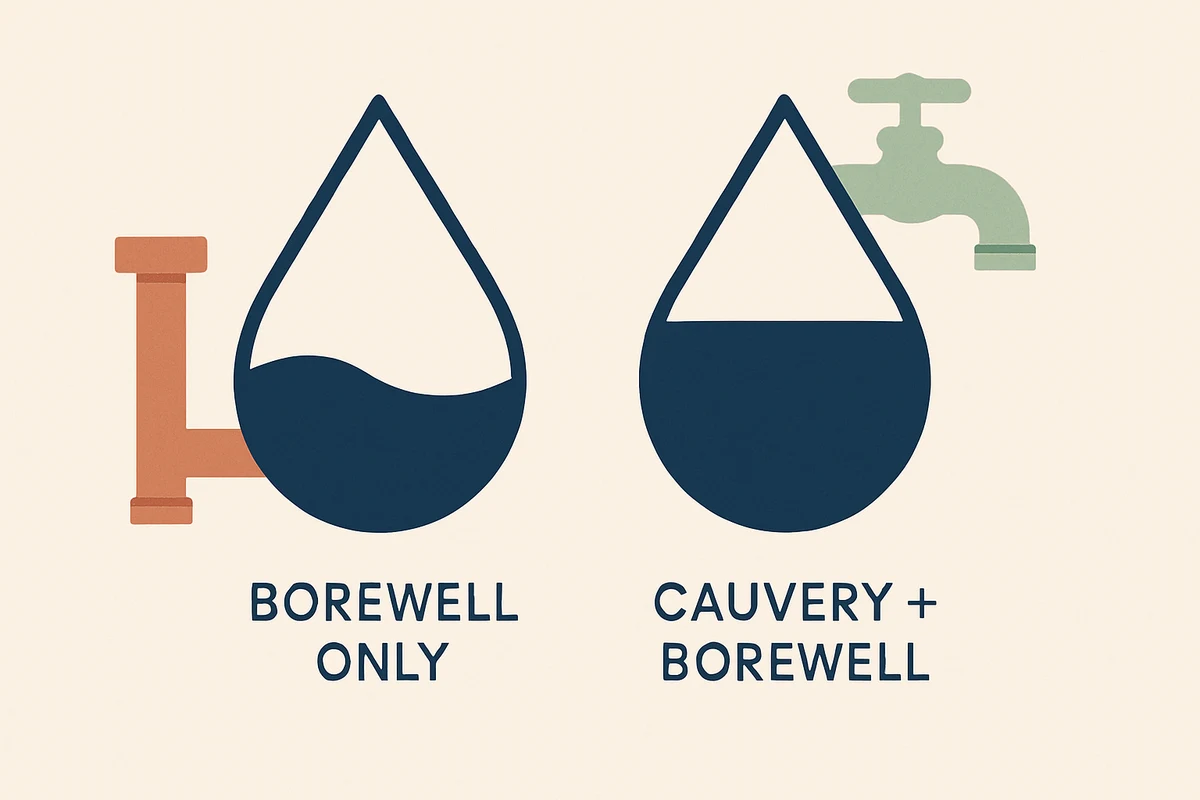
Water is one of the most important Sarjapur questions because a 5,000+ unit high-rise phase needs reliable daily supply, storage, treatment, and reuse. Peripheral Bengaluru locations often rely on a mix of borewells, tankers, treated water, rainwater harvesting, and future municipal connections. A buyer should not accept “24x7 water” as a complete answer. The useful answer is the source mix, design capacity, backup plan, and timeline for municipal connection.
Cauvery Stage VI is an important public-policy signal. Recent coverage says Karnataka approved a Stage VI project intended to support Bengaluru’s fast-growing outskirts and benefit a large population. Sarjapur is part of the broader peripheral-growth conversation. This improves the long-term water narrative, but it does not guarantee that every apartment in Amberstone Vectra receives Cauvery water from day one of possession. Government approvals, tendering, trunk lines, last-mile distribution, project connections, and commissioning can take time.
For Amberstone Vectra, the buyer should ask what happens under three scenarios. Scenario one: Cauvery infrastructure and project connection are available by possession. Scenario two: bulk infrastructure is progressing but not fully connected to the township. Scenario three: municipal supply is delayed and the project must operate on internal sources and tankers for longer. A credible water plan should handle all three scenarios.
STP and treated-water reuse are part of the answer. In a large township, treated water can support flushing, landscaping, and some non-potable uses, reducing pressure on fresh water. But STP capacity, odour control, maintenance, and distribution quality matter. A poorly run STP can become a quality-of-life issue. A well-run STP can make the township more resilient.
Ask direct questions before booking: how many borewells are planned, what is the estimated daily demand, how many days of underground and overhead storage are designed, what tanker backup is assumed, whether Cauvery-ready plumbing is built into the internal network, where STPs are located, and how treated water is reused. These questions are practical, not negative. They are exactly what a serious buyer should ask for a township of this scale.
The final water view is conditional but not pessimistic. Amberstone Properties' scale and brand may help with planning and engagement, and Stage VI gives a better long-term backdrop than a location with no public-water pathway. Still, the buyer should treat water as a verification item until the project-level source plan is in writing.
The best way to test Amberstone Vectra’s location is to build a weekly routine map. Start with work. Where do the earning members travel on Monday morning? What is the route at 8:30 AM, not 2 PM? Is there a metro-and-cab combination that actually saves time, or does it add friction? If one spouse works in Whitefield and another works near Manyata or Bellandur, the same location may feel very different to each person.
Next map school and childcare. If children are already enrolled, test that exact commute. If children are future planned, identify realistic schools rather than the nearest school on a map. Admissions, curriculum, language, fees, bus routes, and peer group matter. A five-minute school is useful only if it is a school the family would genuinely choose.
Then map healthcare. Identify the nearest clinic for routine needs, the nearest reliable emergency hospital, and the hospital you would use for specialty care. Drive the route once in normal traffic and once in a busier window if possible. Sarjapur can be practical, but healthcare comfort is a personal threshold.
Map groceries, repairs, domestic help, and deliveries. In a mature neighbourhood these are invisible conveniences. In an emerging corridor they can be uneven. A large township may attract better services over time, but early residents should be prepared for some friction. Ask nearby residents what delivery apps, cab services, internet providers, and domestic-help networks actually work today.
Map weekends too. If the family’s weekend life is built around Whitefield malls, restaurants, sports classes, friends, or religious/community centres, the distance matters. If the family prefers township amenities and quieter weekends, Sarjapur may feel comfortable sooner. The right location is the one that matches actual behaviour, not aspirational behaviour.
Finally, repeat the test against alternatives. Compare Amberstone Vectra with TVS Altura, Whitefield, a Whitefield resale, and one non-East-Bangalore option using the same weekly routine. This makes the decision fair. A project can look far on paper but work for your routine; another can look close but fail during peak hours.
The location decision should end with a simple sentence: “This works for our weekdays because...” If the buyer cannot complete that sentence with evidence from route tests, school mapping, and service checks, the location still needs more research before booking.
Drive office, school, and hospital routes at real timings before treating brochure minutes as reliable.
Check cab, delivery, broadband, domestic help, groceries, and repair access around the actual site.
Compare Sarjapur with Bellandur and Whitefield using the same family routine, not just the same price.
A green flag is route redundancy. If the project can reach key destinations through more than one practical route, residents are less vulnerable to one junction, toll delay, or roadwork. Ask local drivers which routes work during peak hour and which routes fail during rain. A location with only one comfortable route is riskier than it appears on a map.
A green flag is clustering by reputed developers. Amberstone Properties, Godrej, and other branded launches in the Sarjapur-Bellandur belt suggest that multiple developers see long-term demand. Developer clustering can attract retail, services, schools, and buyer attention. The caution is supply: many launches also mean future resale competition, so entry price and unit selection still matter.
A green flag is improving infrastructure that is already visible or under execution. Existing Sarjapur Main Road access is tangible. Sarjapur metro sections and expressway progress can be tracked. Proposed metro narratives are less certain until approvals and timelines are firm. Buyers should separate visible infrastructure from possible infrastructure.
A red flag is a commute that only works in sales-office timing. If the project feels well connected on a weekend but fails during weekday peak hours, the location may not suit an end user. Always test routes at the exact time your household will use them. If you cannot test now, mark commute as unresolved.
A red flag is vague water language. For a large township, “adequate water” is not enough. Ask for the planned source mix, storage capacity, STP reuse, tanker backup, Cauvery-readiness, and contingency if borewell yields reduce. Water answers should be operational, not only reassuring.
A red flag is assuming Chambenahalli will reach the maturity of central Sarjapur Road by a fixed date. Sarjapura Hobli is rooftopping unevenly. Some services may arrive quickly as occupancy grows; others may lag. Buyers should be comfortable with a transition period after April 2028 possession rather than expecting full daily-life maturity at handover.
A practical way to use this location page is to turn it into a meeting agenda. Instead of asking the sales team broad questions such as whether the project is good, ask for the exact commute, schools, hospitals, water, services, and road access details that affect your decision. Specific questions get specific answers, and specific answers are easier to compare with documents later.
Keep a written version history. Launch-stage projects change quickly: pricing slabs move, tower availability changes, RERA documents appear, payment schedules are refined, and amenity phasing becomes clearer. When you receive an answer, record the date, person, document name, and whether the answer came from a brochure, email, cost sheet, RERA upload, or verbal discussion.
Do not treat the first available unit as the only opportunity. Large projects often create urgency through EOI windows and preferred-unit availability, but the buyer still needs to check whether that unit fits budget, routine, floor preference, view, and resale logic. A less glamorous unit that fits the decision framework can be better than a rushed premium unit.
The key document for this page is the buyer’s own route log plus written water-source and access notes. If that document is not yet available or does not answer the question clearly, mark the item as pending rather than resolved. Pending items do not always mean “do not buy.” They mean the buyer should avoid converting interest into a binding commitment until the uncertainty is proportionate to the amount being paid.
Every Amberstone Vectra decision also has an opportunity cost. The same budget may buy a smaller but more mature Whitefield resale, a different branded Sarjapur launch, a Whitefield apartment, a North Bangalore option, or a lower-risk ready home. The location decision is stronger when the buyer can explain why Amberstone Vectra remains preferable after those alternatives are honestly considered.
The final location takeaway is that Sarjapur offers infrastructure-led upside but does not yet provide the mature convenience of Whitefield or central East Bangalore. If that trade-off is acceptable, the next step is to test weekday routines before treating the location as personally suitable. If it is not acceptable, the buyer should pause, collect more evidence, or compare a different configuration or location before paying further.
Location should be rechecked immediately before Agreement of Sale, not only during the first site visit. Road works, traffic patterns, nearby construction, access routes, and service availability can change during a launch cycle. A second visit at a different time of day often reveals details the first visit misses.
Buyers should also speak to people who are not selling the project: nearby shopkeepers, drivers, residents in neighbouring layouts, school transport operators, and local service providers. They can offer practical insight into water, traffic, safety, deliveries, and area growth that does not appear in brochures.
If the household is relocating from a mature area, spend time in Sarjapur beyond the project gate. Eat nearby, check grocery options, try cab booking, inspect the approach after sunset, and drive to Whitefield in traffic. A location decision becomes much clearer when it is experienced as a normal day rather than a site-tour event.
The last practical location check is to imagine the first month after possession. Where will groceries come from, who will fix an appliance, how will guests find the gate, what happens if a child is sick at night, how easy is the office route during rain, and where will the family go on weekends? If those answers feel workable, Sarjapur’s future upside becomes easier to hold. If they feel uncertain, keep researching before turning interest into commitment.
Survey No. 131, Sarjapura Hobli, Chambenahalli, off Varthur-Sarjapur Main Road, Bengaluru Urban district, Karnataka 562125. Coordinates are approximately 12.8553°N, 77.7468°E. The site is ~5 minutes off the Varthur-Sarjapur Main Road arterial.
Approximately 2.5 km. The Sarjapur metro station sits on the Sarjapur-Hebbal Phase 3 Blue Line, targeted for operations in the 2028-2030 window, broadly tracking the project's April 2028 possession date.
Wipro Sarjapur (~10 km), Bellandur tech parks (~18 km), Marathahalli (~22 km) and Whitefield / ITPL (~25 km) form the daily commute orbit. Drive times depend heavily on peak-hour traffic on the Varthur-Sarjapur Main Road feeder - test the route at your real office time before booking.
Kempegowda International Airport is approximately 55 km away via Sarjapur Road and the Outer Ring Road, an 80-100 minute drive depending on traffic. Sarjapur Road residents typically allow extra buffer for inter-state travel.
Day-to-day groceries, schools and clinics exist along the Varthur-Sarjapur Main Road feeder. The densest premium school and specialty-hospital options sit deeper into the Sarjapur-Bellandur arterial. Sarjapura Hobli is still maturing socially; rooftops are increasing along the corridor and infrastructure is expected to thicken toward April 2028.
Drive from the site to your actual office at peak hour, test weekend routes to the school and hospital you would actually use, and check the Varthur-Sarjapur Main Road feeder at 8:30 AM and 7:00 PM. Confirm the permanent resident-entry approach with Amberstone Properties separately from any temporary sales-office route.
Amberstone Vectra Schools, Hospitals, Retail and Daily Life
The social infrastructure question is where Sarjapur’s transition becomes visible. Basic schools, clinics, local markets, and highway access exist, but premium schooling, specialty hospitals, malls, and dense food/retail choices are stronger closer to Whitefield, KR Puram, and Whitefield. A buyer should separate immediate essentials from aspirational lifestyle infrastructure. The project can still be a good purchase if essentials are manageable and the buyer expects the wider ecosystem to improve by possession.
School choice is personal and often non-negotiable. A project can be five minutes from a school and still not solve a family’s education needs if the curriculum, reputation, commute, admission, language, or extracurricular expectations do not match. Families with children should identify two or three realistic schools today and test the commute at school timings. They should also ask whether any internal school or education parcel is a committed township feature or only a long-term possibility.
Healthcare should be mapped by urgency. Nearby clinics and smaller hospitals may handle routine care, but families should identify the nearest reliable emergency hospital, maternity care, pediatric care, and specialty facility. Time to healthcare matters more than distance on a brochure. If the route crosses busy junctions or highway sections, the buyer should be realistic about night-time and peak-hour access.
Retail and entertainment are lifestyle comfort indicators. Sarjapur’s everyday retail base is improving, but buyers expecting Phoenix Marketcity-style retail or Whitefield restaurant density at the doorstep may feel the location is still early. Internal convenience retail in a large township can reduce friction, but it does not fully replace a mature urban high street or mall ecosystem.
Daily life also includes domestic help availability, delivery coverage, internet service, cab availability, school transport, repair services, pet care, and safety after dark. These are rarely in project brochures, yet they shape the first year after possession. Buyers should ask nearby residents and service providers how the area works today and how it is changing.
The balanced social-infra view is that Amberstone Vectra is a future-comfort play. It should improve as rooftops increase and developers cluster in the corridor. But families moving at possession should still prepare for a location that may be functional before it is fully polished.